PEN American Center - Conversation: Eisa Ulen, Bridgett Davis, Martha Southgate, and Chris Jackson
A great discussion on books by black female authors. Glorious by Bernice McFadden, What Mother Never Told Me by Donna Hill and other great books. Check out this informative discussion and please share with your friends.
Saturday, September 18, 2010


Tuesday, August 31, 2010
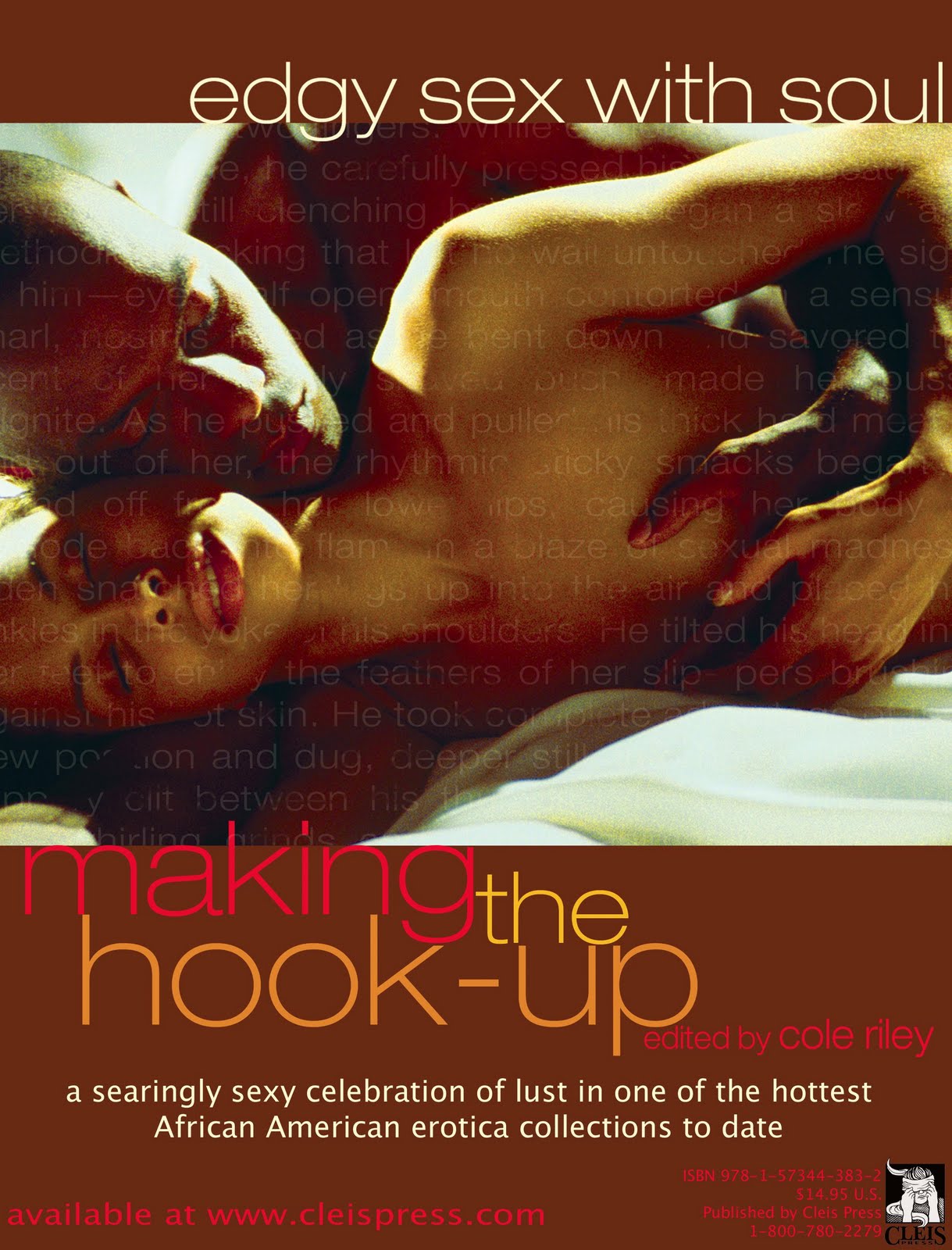
Hello Cole. Thanks for taking time to chat with me. I know you just had a national cyber-chat with your book, Making The Hook-Up, and there was a large ad featured in Essence Online. We want to hear all about that and more. So let's get this party started!
Q. You must have been surprised when the legendary writer Ishmael Reed mentioned you, Cole Riley,in his latest book, Mixing It Up, as one of the influences in the work of Richard Price and George
Pelacanos, one of the writers for the HBO series, The Wire.
I was so honored because Ish Reed is one of my inspirations. I've read him from my younger days as a poet.As a writer, you never know how many people are following your work. For example, there is a master writer and journalist, Maxim Jabowski, who is a fan of mine in England. He used some of my work in one of his internationally known collections. When I issued the call for the Cleis collection, Making The Hook-up, Iwas surprised at how many writers had heard of my work abroad. I had several submissions from writers internationally.
Q. Tell me about the book, Making The Hook-Up. How did the project come about?
I took the idea from a conversation with Calvin Herndon, a noted writer from the 1960s and the author of the hugely popular book, Sex And Racism. He also wrote a controversial novel, Scarecrow, which cause a stir among the critics in the literary world. However, his work and theories were really well known in his day.
When I was going through one of my notebooks, I found several quotes from him during a day I spent with him years ago. He said: "When Black people are allowed to indulge the usual sins, the customary fetishes, and all the regular vices humans are permitted, then they will have achieved total sexual citizenship. Otherwise, they will remain trapped in the usual stale stereotypes and labels the world have assigned to us."
I built the collection of short stories around this concept. For me, I knew exactly what he was saying. Black people have internalized so much of the crap that has been said about them. We have enslaved ourselves sexually and emotionally. With my collection, I wanted to broaden the psychological and sexual
terrain of the Black community.
Q. How did you want to accomplish this mission through your collection?
In the stories of this collection, I wanted to show our people as sexual beings reflecting joy, pleasure, and other positive emotions. I wanted to show them as masters of sexual and emotional choices, and not slaves of urges and impulses. A wonderful friend from Canada, who is originally from Chicago,came in possession of a box of letters from one of her beloved aunts. The letters were a treasure trove.
They were from the Depression, during the time of the reign of FDR. The letters spoke of her love for her devoted husband, her family, her children, her elders. The emotions were genuine and authentic.She shared some of the letters with me. It floored me to see how proud of her family, her race, and community she was. None of the bitterness or anger. She was also proud of her womanhood and sexuality. We don't see that anymore.
There is an ongoing battle between our sexes in our race. Something in terms of positive emotions is lacking. There is no romance there. No emotional support exists as in our elders from days past. And it's not just affecting our men and women but it is impacting our children as well. It's reflected in our culture, our arts, our life, our music, this anger, this distrust,this division, this rage.
A Jamaican writer friend said we as Black Americans must forgive ourselves and others who have participated in our emotional and psychological decline. Otherwise we will continue to kill, rape, and downgrade each other. We're doing ourselves in. I agree. Look at the other communities and cultures, some of which have just come to our shores. They are thriving. So I wanted to start to reverse some of this trend and it has put some issues on the table to be discussed.
Q: How was your relationship with Cleis Press?
I have nothing but good things to say about them. They were open to all of my suggestions and ideas. They are very good business people. Their books are known around the world. One of the writers, who was in Thailand, saw my book. We are in talks to do another collection.
Q: I've known you for some time but introduce yourself to the readers.
I'm the literary alter-ego to an award-winning journalist and editor, who made his mark in the New York newspapers. But in another life, I assumed my pen name of Cole Riley back in the late 1970s. I used to run the streets, hang out with the bad guys, and do thug foolishness. I was a lost soul. I had been physically and emotionally abused as a kid. I would use some of the stories from that life in my early books. Then I got my life straight and saw the light.
I guess I always wanted to be a writer. I always found time to read. When I was young, I read books by Richard Wright, Langston Hughes, Charles Dickens, John Steinbeck, Ernest Hemingway, Flannery O' Connor, Frank Yerby, and Ann Petry. When I started writing,I used all of the things I read in those books.
Q: Tell us about your publishing journey.
I was very young. I was very broke and needed money. My landlord told me that I would be evicted if I didn't get his rent. At that time, before Terri McMillian's splash, Holloway House was the only place that published people like me, unschooled and untrained. I remember I got a note from Iceberg Slim, aka Robert Beck, the author of the classic novel, Pimp, when I sent him part of my novel. I loved it. Once I published Hot Snake Nights, I was off and running.
My books provided me with the imagination, passion and an outlet for my rage and turmoil. I saw some ugly things. I had lived a screwed-up early life. My folks divorced when I was in my teens. I left home very early on, just wandering. I was shell-shocked during my twenties. Those early Cole Riley novels gave me confidence to do everything in my legit writing life. All of them are still in print both here and abroad. That is so pleasing to me.
Q: Social networking is the thing now. What are you doing in regard to that?
Keeping an online presence is vital. Cleis has provided me with access to many readers through the internet. In a few weeks, I will have a presence with a blog, Facebook, Twitter, and a My Space page. Also, Eden Fantasy, where I've just become a contributor, has allowed me to reach "friends" and "followers." For example, it has been a trip to answer some of the questions from the fan base that I'm building. All races, all classes, all stripes of the sexual realm. Sure, you're hoping to move product but it's about wanting them to see that you are worth their time, that you have something to say. They're tired of this reality show crap. They want real life and you want to provide them with that. It's fun. I have a wholly new crossover audience. And I love it.
Q: How do you keep your writing identities separate?
By keeping busy on all fronts, I work under both names. I have projects under both names. I am a workaholic as you know. We're in talks for several future projects. I work on several projects at one time like yourself. I'm addicted to writing. I'm addicted to writing in various genres. I keep several notebooks with ideas. I never get writer's block.
Q: What about digital publishing? The whole e-book format.
I've been approached by different publishers to do strictly e-books. I've not bought a Kindle but I know a friend who has one. They are cool, but I love the feel of books. Call me old fashioned. However, digital publishing is the wave of the future. My Cleis collection is available in e-book form. I'd like to get into it.
Q: What are your morning rituals?
In the morning, I read and revise. I try to work until I get it right. I usually do my serious writing during the afternoon and at night. No cars, no trucks, the city at an uneasy rest. Sometimes I work on a project until I fall asleep.
Q: What are some of your favorite books?
Recently, I've been reading a lot of non-fiction books, autobiographies and biographies, and political essays. The present state of the world interests me to no end. I've been terribly disappointed in our leaders. But the fiction relaxes me. I love the biting satire of Ish Reed, the protest of James Baldwin, the righteousness of Steinbeck, the dark desires of Patricia Highsmith and Ruth Rendell, and the economy of Hemingway. Every now and then, I re-read Carroll's Alice In Wonderland, and was very disappointed in the movie. I love crime and mystery novels, new and old. Currently, I'm reading Steig Larsson's The Girl Who Played With Fire and The Girl With The Dragon Tattoo. Damn, that man could write.
Q: Do you have encouraging words for aspiring authors?
I think aspiring writers have an obligation to push the literary envelope. Don't play it safe. Take risks and take chances. Timeis going fast. We have a duty to encourage our readers to challenge themselves in every way. Don't waste time. If you want to write, write like your life depends on it.
Q: What's on the horizon?
The initial response to Making The Hook-Up has been very positive. My next project for them will be a collection spotlighting romances of risk and consequence. Sex is a part of everyone's life. There is a difference between erotica and porn. Henry Miller, Anais Nin, D.H. Lawrence
and James Baldwin wrote erotica. Also, I'm editing a collection of short stories of the blues for a Scottish publisher. And we're in talks to do another Cole Riley mystery, Night Beat, for Hard Case.
Thank you "Cole" for sharing your story with us. Continued success. We'll see you on the shelves!
Sunday, August 08, 2010
Wednesday, August 04, 2010
PuNanny Diaries - trailer
Have you all checked out the hilarious internet series the PuNanny Diaries... the story of Not getting any? Here is the trailer to give you a hint.
Tuesday, August 03, 2010
Monday, August 02, 2010
African American Literary Awards Show
The 2010 African American Literary Awards is rapidly approaching. The nominations are up. And just like American Idol, its up to you who wins. So CAST YOUR VOTE TODAY. It only takes a minute.
Wednesday, July 28, 2010
A small peek at a novel that I'm working on for my Master's thesis. It will be a collection of vignettes that paint the picture of a family in strife and a neighborhood that is changing right out from under them. This is an excerpt entitled LENA.
Lena
Lena
Jane Austen for the 21st Century
I'd been hearing about this video for a little while, and since I was surfing around, I decided to check it out. It's quite funny and gave me some ideas which I'm going to have to figure out how to pull off. I actually have Jane Austen's Emma on my list of books to read before the year is out. Anyway, enjoy.


Tuesday, July 27, 2010
Readers Survey
I want to take the pulse of my readers. I want to know what you think, what you want and don't want. I've created a short survey to help me be a better writer for you. Your anonymous input is important. So, please take a moment and let me know what you think.
Readers Survey
Readers Survey
Friday, July 23, 2010
Own Your Own Power Conference
If you are ready to step up your game, personally and professionally, if you need direction, resources and support and inspiration that OWN YOUR OWN POWER CONFERENCE is the place to be. Columbia University, New York, NY.
The keynote speaker is Randall Pinkston, the first AA to win the Apprentice. I will be doing a guest appearance as well on getting into and staying in the publishing game.
Check out the link here for information, how to register and how to be a vendor to get your name and product out there.
SAVE THE DATE. SEPTEMBER 18, 2010
The keynote speaker is Randall Pinkston, the first AA to win the Apprentice. I will be doing a guest appearance as well on getting into and staying in the publishing game.
Check out the link here for information, how to register and how to be a vendor to get your name and product out there.
SAVE THE DATE. SEPTEMBER 18, 2010
Hot Fun in the Summertime!
"Hot Fun in the Summertime," is one of my all-time favorite songs by Sly Stone. And I have to admit it totally applies right now. I've been so bogged down in writing and working and school work that while my head was down in the sand, the publishing world kept on moving and is putting out two original titles of mine to help keep the summer sizzle going.!
First up is HEARTS REWARD. The final book in the "Millionaire Matchmaker" series. (check Celeste Norfleet and Adrienne Byrd. They kicked off the series) My story wraps it up and features the owner of the Platinum Society Melonie Harte. She's smart, sexy, business savvy and believes she is content. Her job is to bring the elite together with others like themselves in a perfect match. Her business makes mega-cash and its run with the help of her nephew and two nieces. Melonie's life is all that and then some until her FINE brother Alan introduces her to Claude Montgomery. Ooooh la la. To compound matters, Senator Lawson wants Melonie's help in finding someone for his playboy son, Rafe Lawson. Needless to say you wouldn't kick either of these brothers out of bed. The problem is, mixing business with pleasure is a "no-no." What's a matchmaker to do?? Fun, sexy, with a little love triangle thrown in. I know you will enjoy it and you will get a glimpse of the Lawson family that will debut in the Spring with "Spend My Life With You."
And right on the heels of Heart's Reward is PRIVATE LESSONS. Straight-laced Naomi Clarke a tenured college professor at Atlanta University goes on vacation to the island of Antigua (yes, I love Antigua and I want my characters to love it too). But her conventional mindset is put to the test when she meets Brice Lawrence, whose Adonis body and brilliant mind are the ultimate turn-on. A little island fling. No big deal. She'd go home and never see him again. Not!!! Is that Brice sitting in the back of her classroom on the first day? OMG. Now what?
What's a reader to do? Well, I hope you will get your copies, pop them in your beachbag, tote or back pocket and enjoy. And do let me know what you think! Happy reading.
First up is HEARTS REWARD. The final book in the "Millionaire Matchmaker" series. (check Celeste Norfleet and Adrienne Byrd. They kicked off the series) My story wraps it up and features the owner of the Platinum Society Melonie Harte. She's smart, sexy, business savvy and believes she is content. Her job is to bring the elite together with others like themselves in a perfect match. Her business makes mega-cash and its run with the help of her nephew and two nieces. Melonie's life is all that and then some until her FINE brother Alan introduces her to Claude Montgomery. Ooooh la la. To compound matters, Senator Lawson wants Melonie's help in finding someone for his playboy son, Rafe Lawson. Needless to say you wouldn't kick either of these brothers out of bed. The problem is, mixing business with pleasure is a "no-no." What's a matchmaker to do?? Fun, sexy, with a little love triangle thrown in. I know you will enjoy it and you will get a glimpse of the Lawson family that will debut in the Spring with "Spend My Life With You."
And right on the heels of Heart's Reward is PRIVATE LESSONS.
 Straight-laced Naomi Clarke a tenured college professor at Atlanta University goes on vacation to the island of Antigua (yes, I love Antigua and I want my characters to love it too). But her conventional mindset is put to the test when she meets Brice Lawrence, whose Adonis body and brilliant mind are the ultimate turn-on. A little island fling. No big deal. She'd go home and never see him again. Not!!! Is that Brice sitting in the back of her classroom on the first day? OMG. Now what?
 What's a reader to do? Well, I hope you will get your copies, pop them in your beachbag, tote or back pocket and enjoy. And do let me know what you think! Happy reading.
Wednesday, July 21, 2010
A New Series Has Begun Along with Concerns
On Monday, after pulling an all-nighter ( I am much too old for that--and paid for it), I turned in my manuscript to my Harlequin editor, which is the first book in my brand new series The Lawsons of Louisiana. This first book, I entitled FOR YOU I WILL. Because that's what I wanted it to say. It is what the book meant to me.
However, in a back room somewhere, folks sat around and figured they knew my story better than I did and of course they knew what the public wanted. (of course). Alas, they changed my title to Spend My Life With You-- which to me sounds weak and ordinary, not a clear, no nonsense declaration--like my original title.
Anyway, that's the new, damn title. But by the time I finished having a professional hissy, fit, I was assured that would not happen again.
The point of my story is, behind the title is a kicking story about a wealthly, black, political family based in Louisiana, complete with sexy characters, political drama, love triangles, scandals and did I mention hot sex?
This is the first of what we hope will be a continuing series that readers with latch onto and love. So far the series is slated for four books.
For those who read or will read very soon my current summer release HEART'S REWARD, (available wherever books are sold)you will get to meet the edible Rafe Lawson, oldest son and heir apparant to Branford Lawson the patriarch of the Lawson clan.
I really enjoyed putting the first book together and look forward to writing the rest of the series.
In the meantime, check out the short reading excerpt from Heart's Reward. I'm sure you will love it.
I'll be posting little excerpts from my summer releases ( Private Lessons--coming soon, Scandalous and A Scandalous Affair (re-issues) throughout the summer. So come back often.
I would love to hear your thoughts on the change of title. What do you think? How much do titles matter?
Tuesday, July 20, 2010

Thursday, May 06, 2010
Interview with Virginia Deberry & Donna Grant
Hello Ladies! Thank you so much for taking time to chat with me. You have so much going on and I know that readers for this blog are anxious to hear it all. So let's get started!
Q. The novelty of a writing duo will never wear off at least not for me! How long have the two of you written together and how do you make it work?
This probably speaks to some kind of group insanity we have always shared, but even from the beginning writing in tandem never seemed like an unusual idea. Before we wrote novels, we worked on a fashion newsletter and a start-up magazine together. That is where we learned we have an intuitive ability to collaborate and have a great time doing it. That happened 20+ years ago. When the magazine folded, the one thing we knew for sure was that we had to keep working together, because that made sense! Neither of us remembers who came up with the idea of writing a novel. We investigated other possibilities first, but the novel won out, and we've been doing it ever since.
The most challenging part of keeping it going, is managing the time it takes to do it. We really do write together—in the same room, mostly at the same computer. That means we spend a lot of time in the writing cave and away from family and friends, which is hard. We have been working on creating more balance—it’s a work in progress. Fortunately, the ideas are in no short supply and the mutual respect we have for each other’s talent and point of view means we still enjoy sitting down together and seeing what we can cook up.
Q. I've known you both for quite some time, but please share with the readers your individual backgrounds, where you grew up, loves/marriages, and when the writing bug bit you.
DG: I’m a Brooklyn, NY girl (I realize girl is a bit of a stretch), and my husband and I still live there. Brooklyn is a bubbling caldron of life and creativity—people from different backgrounds produce music, dance, art and the written word from a variety of traditions, and there are so many people per square foot that you can’t help but be influenced by each other. Some days it’s exhausting, but never boring.
My husband, Hiram, is an around the way guy—we were born 30 days apart in the same hospital and lived literally around the corner from each other as kids, but we didn’t meet until we were grown. New York can be like that, but after 25 years together, 23 of them married, we’ve made up for lost time.
Reading and writing have been part of my life for as long as I can remember. From Hans Christian Andersen and The Brother’s Grimm, to Dr. Seuss and cereal boxes, I’d read anything as a child. Mom was a big reader—she always had a novel going and when she’d ride the subway she always had her book to read, so I had my storybook too. I get a big charge out of watching someone reading one of our books on the train. I discovered my own facility with words pretty early—I wrote stories and poems, founded a class newspaper in fifth grade (printed on that really smelly mimeograph paper) and have been writing ever since.
VDB: I was born in a tiny town in North Carolina (left when I was a wee tot), grew up in Buffalo, moved to NYC in the early 80’s where I lived until ’92 when Donna and I really buckled down with this writing thing and I realized that being a starving artist in the city was more romantic to read about than actually live. I need to be in a place that was quiet, with grass and trees and parking, so I crossed the border. I’m now a Jersey girl—a transplant who took root in smack in the middle of the Garden State—New York is an hour north and Philly is an hour south. I’m living my life in the ‘burbs and lovin’ it.
I like to say that I am currently “husband free” and have been for a long time. I’ve been married twice, and divorced twice and am utterly at peace in the knowledge that all of us are not meant for matrimonial bliss. I’m not sayin’ “never again”, but I’m single and happy. I date and have wonderful friends and as full a social calendar as I want.
I don’t know if I was bitten by the writing bug or born with some kind of congenital defect that predisposed me to developing the disease—but like Donna, reading and writing have been a part of my life for as long as I can remember. As a child, I always wanted a story and if someone wasn’t telling or reading me one, then I was making up my own. I have an old photograph of my brother and sister and me on Christmas morning—I must be about ten and we’re each holding our favorite Christmas gift. I’m hugging my brand new, bright orange Tom Thumb Typewriter! The die was cast early!
Q. You both are on a whirlwind tour and have been keeping readers abreast of your activities via Twitter, Facebook etc. When we all started out, technology wasn't much help. How have you both learned to make it work effectively for you?
Our very first book, Exposures—which we wrote as Marie Joyce—was written on a typewriter that had six pages of memory. When we finished those six pages to our satisfaction, we would print them out on three-part NCR paper (that was smelly too), erase the memory and start again. When we got revisions, we had to type the whole manuscript again. We are truly grateful for technological advances.
When we first included an email address in Tryin’ to Sleep in the Bed You Made, our publisher didn’t even have email. At that point we got more snail mail than email, but over time the balance has definitely shifted. We always saw an advantage to having a direct line of communication with our readers and we’re glad they enjoy sharing their thoughts. Fast forward to facebook, myspace, Twitter etc.—it’s still all about ways to share information and have some fun. Social networks have also allowed us to stay in touch with other writers. Virginia is the Techno-wiz of the two of us. She enjoys finding the way to work with each new platform and staying on top of the conversation. The trick here too is finding the balance between online communications, working on our books, and having a life. Not always easy. Sometime you just have to step away from the laptop!
Q. What are some things that you would suggest writers do regarding social networking?
These days it’s undeniable that establishing an online presence is important. It’s the surest, most direct way to reach readers. Blogging, Facebook, Twitter are the ones we utilize most. There are two suggestions we can offer in terms of these networks 1) Engage—don’t be one-sided. As often as possible, have a real exchange with some of the folks who are your “friends” and “followers.” That means asking and answering questions. 2) Variety--post about a range of topics, not just your book(s). Let the folks “out there” see some of your personality, let them get to know you—not the intimate personal details of your life, but enough for them to be able to “see” you as a real person, not just somebody who’s selling books. We’re all trying to “move product” and that’s what the social networking sites facilitate so well, but it’s definitely a case of soft selling. Yes, you can post reviews, reminders and links to purchase your book online, places you’ll be signing. But it’s equally important to post about other things that interest you.
Q. Through your years of publishing, what has been your biggest obstacle? And what are you doing, or what have you been doing to combat it?
The obstacles have come in stages. The first was getting published. We ran into the Toni-Terry problem—our writing was not “literary” in the spirit of Toni Morrison, and it wasn’t in the Terry McMillan mold which were the two prevailing categories for black writers. Editors didn’t know where we fit in, so they would pass on the manuscript. We were fortunate to find an editor who appreciated our writing and encouraged us to go ahead and tell the story, regardless of the category. That, was a very big hurdle, one we’re not sure we’d get over if Tryin’ to Sleep in the Bed You Made was being shopped today.
Now, the categories have changed, but the problem is the same. We don’t write urban fiction or erotica, which are the hot categories in African American fiction and now, it’s much harder to get beyond the labels. Publishers are extremely concerned about the bottom line and are most interested in publishing more of what has been successful. It’s like we are all being pressured to write the same book and to compete for the same small piece of the pie instead of being encouraged to find a slice of the bigger pie.
We are looking to find ways to stay in touch with our loyal readers while we also introduce ourselves to audiences who don’t know us yet. We participate in online conversations on sites that are not solely African American and have received many emails that read something like, “I had never heard of you before, but I picked up out one of your books, loved it and will be getting more.” We realize publishing is a numbers game, and that in order to stay in it we have to bring in bigger numbers. The only way we can do that is to make ourselves known to readers across the women’s fiction spectrum. We believe our stories have universal appeal and deserve exposure in the wider marketplace.
Q. There has been countless discussion and debate about how and why black books are segregated in the stores. But even more disturbing the notion that the segregation begins in the publishing houses. Please share your thoughts on this and what can readers do?
All of us who write books with black characters have been made aware of the statistics showing which kinds of our books are selling the most. Along with that knowledge, comes the pressure—subtle or not—to make our books more like those with the biggest bottom lines. Yet, there has been no effort to market our books to a wider audience where we might find additional fans who would appreciate what we do, not what publishers think black authors should do. The basic assumption is that only black audiences will buy and read books by black authors. This is not the assumption with other authors. It is assumed that everyone will read Nora Roberts, James Patterson, etc., including black readers. It is also assumed that not just vampires read Stephanie Meyers’ Twilight series. So, we come out of the gate with a disadvantage.
Also, more and more often novels by African American are shelved in the African American section, not with general fiction. It seems readers are split on this. Some prefer to be able to find the authors they love in a separate section. The consequence of this is that casual book store browsers are unlikely to come across a book by a black writer that they are not looking for specifically, again, limiting our access to the book buying public.
We always tell readers that if there are authors they love, buy their books, otherwise you won’t see their work any longer. None of us are immune from this phenomenon. Also, if you love someone’s work, tell people about it, and not just other African Americans. The more people who know about an author, the better chance she or he will have to stay in the marketplace.
Q. Now let's get to it! Your latest novel UPTOWN hit bookstores March, 2010. What inspired the book?
Real Estate became the national fever in the 2000’s. All of a sudden people were talking about trading up, flipping houses, how much their houses had appreciated and borrowing against the increased value. Developers built luxury housing, often in neighborhoods that had never seen such activity and long-time residents were displaced. When did home go from being the place where you made warm memories with your family, to an actively traded commodity? We chose Harlem as the setting because it has been an iconic African-American community since the early 20th century, but there are communities like Uptown all over the country. We wanted to look at this phenomenon from the perspective of a family whose members were both long time residents of the area, and actively involved in developing the “New Harlem.”
Q. Give us some details about the storyline and why was this story important for you to tell?
The Dixon Group, started by long-time Harlemite and real estate investor King Dixon, and now run by his son, Dwight, owns large parcels of Harlem real estate, some of it bordering Central Park, the gem in the middle of Manhattan. Three of the four sides of the park are lined with luxury residences, hotels, fashionable boutiques and world-renowned museums. Only 110th St., the north side of the park, which was considered the gateway to Harlem, was still lined with tenements, a gas station, a correctional facility—hardly prime properties. But as 110th St began to be called Central Park North, it was clear the game was changing, and the Dixon Group was ready to cash in. What seems like the easiest piece of the puzzle, acquiring a property they need from a family member, turns out to unleash a buried, but long-simmering betrayal that affects Dwight and his cousin, Avery Lyons. They were once as close as brother and sister, but that ended twenty years ago. Now Avery is back in town, and the truth will come out, no matter who it hurts.
Q. Tell us about the characters and the research involved in putting this book together.
This is the first book we’ve started with the male characters, but when we knew the story was about real estate in Harlem, when knew we had already met two of the characters to help us tell it—Dwight Dixon, Jewell Prescott’s fiancé in Better Than I Know Myself, and his overbearing father, King Dixon.
Q. What do you want readers to get from UPTOWN?
We hope they have a read that keeps them wanting to turn the pages and find out what happens next. We also hope to leave readers with some questions to answer. Does success mean that the one with the most money at the end wins, or are there other qualities we expect? What does home really mean? Is it just the building, or is it a feeling we carry with us? If our feelings for home are unsettled, do we ever feel at home, no matter where we go?
Q. What have been some of your marketing strategies for UPTOWN?
We try to keep ourselves available and “out there.” We have been fortunate to still be sent on book tour by our publisher and we try to make the most of the opportunity to travel around the country. With Uptown we were able to visit some cities where we have not been in a long time—like Denver and Dallas, as well as others where we have never been—Augusta, GA, Jackson, MS, Milwaukie, WS and Pittsburgh, PA among them—where it was great talking with fans we had not had the chance to meet previously. In addition to our regular online activities, we have written guest blogs (Thanks Donna!), appeared on blogtalk radio, reached out to book clubs and book bloggers, whatever we can do to get the word out.
Q. Let's talk cover. When I saw the cover, a lot of things went through my head. What are the thoughts behind the cover? What did you want to evoke from the casual browser?
We don’t have final say-so on covers. On our last book, What Doesn’t Kill You, there was another version of the cover that we preferred, but we lost that battle. We actually liked the Uptown cover as soon as we saw it. It feels like a cover that surrounds a big story, one that would make a browser in a bookstore stop and check it out. It also feels like the art director didn’t just find a stock photo and slap it on a page with the title on it. They actually gave it thought and made it reflect the feeling of the book. It also didn’t hurt that our name was above the title—first time that’s happened.
Q. Four Colored Girls. Tell us about it and how it got started.
The full name is 4 Colored Girls Productions. For those of us who remember back when we were called colored girls, the name is meant to pay respect to all that we were taught then about having pride in ourselves and being able to accomplish whatever we set our minds to. We formed the company three years ago, along with partners Tyrha Lindsey and Tracey Kemble, both of who have extensive film production experience. We all met 10 plus years ago, when Tracey, who was an HBO VP at the time, optioned Tryin’ to Sleep in the Bed You Made to produce independently. Tyrha, who reached out to us at about the same time, we working for Qwest Entertainment, the production arm for Quincy Jones. She wanted the option, but Tracey already had it. At the time, Hollywood had very different ideas than we all did about what kind of movie to make out of Tryin’ (like on starring Winnona Ryder and Gweneth Paltrow)., and the movie was never made. But years later, we all still believe there is a wonderful movie to be made from the story, and we intend to produce it.
Q. Where do you stand now with the movie?
Regina King attached herself to the project from the beginning—she was a fan of the book. We did the first several passes at the screenplay and have worked with a screenwriter to polish it. Last year was difficult in terms of raising funds, but the outlook this year has been better. Right now we are at a very important and encouraging point regarding a particular financing avenue, so we are hopeful—and saying our prayers. We’ll definitely keep you posted.
Q. What books are on your list to read this summer?
Gee, it would be great to have a summer like when we were kids—two whole months with no assignments—bliss. The reality has been deadline summers which haven’t left much reading time. Glorious by Bernice McFadden is definitely on the list. She waged such a battle to get the book published and it’s exciting to see it receiving great reviews. You know we love a good read about mothers and daughters, so What Mother Never Told Me is definitely on the list. We each have stacks of books to catch up on. Let’s see how far we get!
Q. Where do you see the future of publishing going, specifically for the black author and reader?
Our crystal ball is not so clear at the moment. Storytelling is a time-honored tradition for humans in general and for those of us of African descent in particular, so we know that stories will continue to be written and shared. As far as publishing goes, the whole industry is scrambling to keep pace with developments in e-book publishing that change the entire reader-writer-publisher paradigm. None of us can rest on what used to work, because we are no longer, “back in the day.” That could be scary, but it can also be invigorating. What it definitely requires is that writers and readers stay active, and open-minded and look to stake our claim in the new media landscape.
Q. What is your next book project and can you share the storyline with us?
We have a few ideas on the table and are continuing to brainstorm. As we have mentioned, this is a difficult moment in publishing, and we are not sure what our next steps will be, but we’ll keep you posted.
Q. Where can readers find out more about you?
They can find all kinds of info, our travel schedule, our contact info and whatever else is on our minds at: on:
deberryandgrant.com
facebook.com/deberryandgrant
twitter.com/deberryandgrant
twomindsfull.blogspot.com

Q. The novelty of a writing duo will never wear off at least not for me! How long have the two of you written together and how do you make it work?
This probably speaks to some kind of group insanity we have always shared, but even from the beginning writing in tandem never seemed like an unusual idea. Before we wrote novels, we worked on a fashion newsletter and a start-up magazine together. That is where we learned we have an intuitive ability to collaborate and have a great time doing it. That happened 20+ years ago. When the magazine folded, the one thing we knew for sure was that we had to keep working together, because that made sense! Neither of us remembers who came up with the idea of writing a novel. We investigated other possibilities first, but the novel won out, and we've been doing it ever since.
The most challenging part of keeping it going, is managing the time it takes to do it. We really do write together—in the same room, mostly at the same computer. That means we spend a lot of time in the writing cave and away from family and friends, which is hard. We have been working on creating more balance—it’s a work in progress. Fortunately, the ideas are in no short supply and the mutual respect we have for each other’s talent and point of view means we still enjoy sitting down together and seeing what we can cook up.
Q. I've known you both for quite some time, but please share with the readers your individual backgrounds, where you grew up, loves/marriages, and when the writing bug bit you.
DG: I’m a Brooklyn, NY girl (I realize girl is a bit of a stretch), and my husband and I still live there. Brooklyn is a bubbling caldron of life and creativity—people from different backgrounds produce music, dance, art and the written word from a variety of traditions, and there are so many people per square foot that you can’t help but be influenced by each other. Some days it’s exhausting, but never boring.
My husband, Hiram, is an around the way guy—we were born 30 days apart in the same hospital and lived literally around the corner from each other as kids, but we didn’t meet until we were grown. New York can be like that, but after 25 years together, 23 of them married, we’ve made up for lost time.
Reading and writing have been part of my life for as long as I can remember. From Hans Christian Andersen and The Brother’s Grimm, to Dr. Seuss and cereal boxes, I’d read anything as a child. Mom was a big reader—she always had a novel going and when she’d ride the subway she always had her book to read, so I had my storybook too. I get a big charge out of watching someone reading one of our books on the train. I discovered my own facility with words pretty early—I wrote stories and poems, founded a class newspaper in fifth grade (printed on that really smelly mimeograph paper) and have been writing ever since.
VDB: I was born in a tiny town in North Carolina (left when I was a wee tot), grew up in Buffalo, moved to NYC in the early 80’s where I lived until ’92 when Donna and I really buckled down with this writing thing and I realized that being a starving artist in the city was more romantic to read about than actually live. I need to be in a place that was quiet, with grass and trees and parking, so I crossed the border. I’m now a Jersey girl—a transplant who took root in smack in the middle of the Garden State—New York is an hour north and Philly is an hour south. I’m living my life in the ‘burbs and lovin’ it.
I like to say that I am currently “husband free” and have been for a long time. I’ve been married twice, and divorced twice and am utterly at peace in the knowledge that all of us are not meant for matrimonial bliss. I’m not sayin’ “never again”, but I’m single and happy. I date and have wonderful friends and as full a social calendar as I want.
I don’t know if I was bitten by the writing bug or born with some kind of congenital defect that predisposed me to developing the disease—but like Donna, reading and writing have been a part of my life for as long as I can remember. As a child, I always wanted a story and if someone wasn’t telling or reading me one, then I was making up my own. I have an old photograph of my brother and sister and me on Christmas morning—I must be about ten and we’re each holding our favorite Christmas gift. I’m hugging my brand new, bright orange Tom Thumb Typewriter! The die was cast early!
Q. You both are on a whirlwind tour and have been keeping readers abreast of your activities via Twitter, Facebook etc. When we all started out, technology wasn't much help. How have you both learned to make it work effectively for you?
Our very first book, Exposures—which we wrote as Marie Joyce—was written on a typewriter that had six pages of memory. When we finished those six pages to our satisfaction, we would print them out on three-part NCR paper (that was smelly too), erase the memory and start again. When we got revisions, we had to type the whole manuscript again. We are truly grateful for technological advances.
When we first included an email address in Tryin’ to Sleep in the Bed You Made, our publisher didn’t even have email. At that point we got more snail mail than email, but over time the balance has definitely shifted. We always saw an advantage to having a direct line of communication with our readers and we’re glad they enjoy sharing their thoughts. Fast forward to facebook, myspace, Twitter etc.—it’s still all about ways to share information and have some fun. Social networks have also allowed us to stay in touch with other writers. Virginia is the Techno-wiz of the two of us. She enjoys finding the way to work with each new platform and staying on top of the conversation. The trick here too is finding the balance between online communications, working on our books, and having a life. Not always easy. Sometime you just have to step away from the laptop!
Q. What are some things that you would suggest writers do regarding social networking?
These days it’s undeniable that establishing an online presence is important. It’s the surest, most direct way to reach readers. Blogging, Facebook, Twitter are the ones we utilize most. There are two suggestions we can offer in terms of these networks 1) Engage—don’t be one-sided. As often as possible, have a real exchange with some of the folks who are your “friends” and “followers.” That means asking and answering questions. 2) Variety--post about a range of topics, not just your book(s). Let the folks “out there” see some of your personality, let them get to know you—not the intimate personal details of your life, but enough for them to be able to “see” you as a real person, not just somebody who’s selling books. We’re all trying to “move product” and that’s what the social networking sites facilitate so well, but it’s definitely a case of soft selling. Yes, you can post reviews, reminders and links to purchase your book online, places you’ll be signing. But it’s equally important to post about other things that interest you.
Q. Through your years of publishing, what has been your biggest obstacle? And what are you doing, or what have you been doing to combat it?
The obstacles have come in stages. The first was getting published. We ran into the Toni-Terry problem—our writing was not “literary” in the spirit of Toni Morrison, and it wasn’t in the Terry McMillan mold which were the two prevailing categories for black writers. Editors didn’t know where we fit in, so they would pass on the manuscript. We were fortunate to find an editor who appreciated our writing and encouraged us to go ahead and tell the story, regardless of the category. That, was a very big hurdle, one we’re not sure we’d get over if Tryin’ to Sleep in the Bed You Made was being shopped today.
Now, the categories have changed, but the problem is the same. We don’t write urban fiction or erotica, which are the hot categories in African American fiction and now, it’s much harder to get beyond the labels. Publishers are extremely concerned about the bottom line and are most interested in publishing more of what has been successful. It’s like we are all being pressured to write the same book and to compete for the same small piece of the pie instead of being encouraged to find a slice of the bigger pie.
We are looking to find ways to stay in touch with our loyal readers while we also introduce ourselves to audiences who don’t know us yet. We participate in online conversations on sites that are not solely African American and have received many emails that read something like, “I had never heard of you before, but I picked up out one of your books, loved it and will be getting more.” We realize publishing is a numbers game, and that in order to stay in it we have to bring in bigger numbers. The only way we can do that is to make ourselves known to readers across the women’s fiction spectrum. We believe our stories have universal appeal and deserve exposure in the wider marketplace.
Q. There has been countless discussion and debate about how and why black books are segregated in the stores. But even more disturbing the notion that the segregation begins in the publishing houses. Please share your thoughts on this and what can readers do?
All of us who write books with black characters have been made aware of the statistics showing which kinds of our books are selling the most. Along with that knowledge, comes the pressure—subtle or not—to make our books more like those with the biggest bottom lines. Yet, there has been no effort to market our books to a wider audience where we might find additional fans who would appreciate what we do, not what publishers think black authors should do. The basic assumption is that only black audiences will buy and read books by black authors. This is not the assumption with other authors. It is assumed that everyone will read Nora Roberts, James Patterson, etc., including black readers. It is also assumed that not just vampires read Stephanie Meyers’ Twilight series. So, we come out of the gate with a disadvantage.
Also, more and more often novels by African American are shelved in the African American section, not with general fiction. It seems readers are split on this. Some prefer to be able to find the authors they love in a separate section. The consequence of this is that casual book store browsers are unlikely to come across a book by a black writer that they are not looking for specifically, again, limiting our access to the book buying public.
We always tell readers that if there are authors they love, buy their books, otherwise you won’t see their work any longer. None of us are immune from this phenomenon. Also, if you love someone’s work, tell people about it, and not just other African Americans. The more people who know about an author, the better chance she or he will have to stay in the marketplace.
Q. Now let's get to it! Your latest novel UPTOWN hit bookstores March, 2010. What inspired the book?

Real Estate became the national fever in the 2000’s. All of a sudden people were talking about trading up, flipping houses, how much their houses had appreciated and borrowing against the increased value. Developers built luxury housing, often in neighborhoods that had never seen such activity and long-time residents were displaced. When did home go from being the place where you made warm memories with your family, to an actively traded commodity? We chose Harlem as the setting because it has been an iconic African-American community since the early 20th century, but there are communities like Uptown all over the country. We wanted to look at this phenomenon from the perspective of a family whose members were both long time residents of the area, and actively involved in developing the “New Harlem.”
Q. Give us some details about the storyline and why was this story important for you to tell?
The Dixon Group, started by long-time Harlemite and real estate investor King Dixon, and now run by his son, Dwight, owns large parcels of Harlem real estate, some of it bordering Central Park, the gem in the middle of Manhattan. Three of the four sides of the park are lined with luxury residences, hotels, fashionable boutiques and world-renowned museums. Only 110th St., the north side of the park, which was considered the gateway to Harlem, was still lined with tenements, a gas station, a correctional facility—hardly prime properties. But as 110th St began to be called Central Park North, it was clear the game was changing, and the Dixon Group was ready to cash in. What seems like the easiest piece of the puzzle, acquiring a property they need from a family member, turns out to unleash a buried, but long-simmering betrayal that affects Dwight and his cousin, Avery Lyons. They were once as close as brother and sister, but that ended twenty years ago. Now Avery is back in town, and the truth will come out, no matter who it hurts.
Q. Tell us about the characters and the research involved in putting this book together.
This is the first book we’ve started with the male characters, but when we knew the story was about real estate in Harlem, when knew we had already met two of the characters to help us tell it—Dwight Dixon, Jewell Prescott’s fiancé in Better Than I Know Myself, and his overbearing father, King Dixon.
Q. What do you want readers to get from UPTOWN?
We hope they have a read that keeps them wanting to turn the pages and find out what happens next. We also hope to leave readers with some questions to answer. Does success mean that the one with the most money at the end wins, or are there other qualities we expect? What does home really mean? Is it just the building, or is it a feeling we carry with us? If our feelings for home are unsettled, do we ever feel at home, no matter where we go?
Q. What have been some of your marketing strategies for UPTOWN?
We try to keep ourselves available and “out there.” We have been fortunate to still be sent on book tour by our publisher and we try to make the most of the opportunity to travel around the country. With Uptown we were able to visit some cities where we have not been in a long time—like Denver and Dallas, as well as others where we have never been—Augusta, GA, Jackson, MS, Milwaukie, WS and Pittsburgh, PA among them—where it was great talking with fans we had not had the chance to meet previously. In addition to our regular online activities, we have written guest blogs (Thanks Donna!), appeared on blogtalk radio, reached out to book clubs and book bloggers, whatever we can do to get the word out.
Q. Let's talk cover. When I saw the cover, a lot of things went through my head. What are the thoughts behind the cover? What did you want to evoke from the casual browser?
We don’t have final say-so on covers. On our last book, What Doesn’t Kill You, there was another version of the cover that we preferred, but we lost that battle. We actually liked the Uptown cover as soon as we saw it. It feels like a cover that surrounds a big story, one that would make a browser in a bookstore stop and check it out. It also feels like the art director didn’t just find a stock photo and slap it on a page with the title on it. They actually gave it thought and made it reflect the feeling of the book. It also didn’t hurt that our name was above the title—first time that’s happened.
Q. Four Colored Girls. Tell us about it and how it got started.
The full name is 4 Colored Girls Productions. For those of us who remember back when we were called colored girls, the name is meant to pay respect to all that we were taught then about having pride in ourselves and being able to accomplish whatever we set our minds to. We formed the company three years ago, along with partners Tyrha Lindsey and Tracey Kemble, both of who have extensive film production experience. We all met 10 plus years ago, when Tracey, who was an HBO VP at the time, optioned Tryin’ to Sleep in the Bed You Made to produce independently. Tyrha, who reached out to us at about the same time, we working for Qwest Entertainment, the production arm for Quincy Jones. She wanted the option, but Tracey already had it. At the time, Hollywood had very different ideas than we all did about what kind of movie to make out of Tryin’ (like on starring Winnona Ryder and Gweneth Paltrow)., and the movie was never made. But years later, we all still believe there is a wonderful movie to be made from the story, and we intend to produce it.
Q. Where do you stand now with the movie?
Regina King attached herself to the project from the beginning—she was a fan of the book. We did the first several passes at the screenplay and have worked with a screenwriter to polish it. Last year was difficult in terms of raising funds, but the outlook this year has been better. Right now we are at a very important and encouraging point regarding a particular financing avenue, so we are hopeful—and saying our prayers. We’ll definitely keep you posted.
Q. What books are on your list to read this summer?
Gee, it would be great to have a summer like when we were kids—two whole months with no assignments—bliss. The reality has been deadline summers which haven’t left much reading time. Glorious by Bernice McFadden is definitely on the list. She waged such a battle to get the book published and it’s exciting to see it receiving great reviews. You know we love a good read about mothers and daughters, so What Mother Never Told Me is definitely on the list. We each have stacks of books to catch up on. Let’s see how far we get!
Q. Where do you see the future of publishing going, specifically for the black author and reader?
Our crystal ball is not so clear at the moment. Storytelling is a time-honored tradition for humans in general and for those of us of African descent in particular, so we know that stories will continue to be written and shared. As far as publishing goes, the whole industry is scrambling to keep pace with developments in e-book publishing that change the entire reader-writer-publisher paradigm. None of us can rest on what used to work, because we are no longer, “back in the day.” That could be scary, but it can also be invigorating. What it definitely requires is that writers and readers stay active, and open-minded and look to stake our claim in the new media landscape.
Q. What is your next book project and can you share the storyline with us?
We have a few ideas on the table and are continuing to brainstorm. As we have mentioned, this is a difficult moment in publishing, and we are not sure what our next steps will be, but we’ll keep you posted.
Q. Where can readers find out more about you?
They can find all kinds of info, our travel schedule, our contact info and whatever else is on our minds at: on:
deberryandgrant.com
facebook.com/deberryandgrant
twitter.com/deberryandgrant
twomindsfull.blogspot.com
Monday, May 03, 2010
Interview with Trisha Thomas

Hey Trisha. Thanks so much for taking time to answer my very intrusive questions, but I'm sure readers will appreciate your responses.
Q. Readers are always interested in who we are outside of being a writer. Tell us about Trisha, the woman.
Creativity is the first thing that comes to mind. If you ask any of my close friends to describe me, that’s the first word they’d use. My house looks like a big art gallery from my own work. Huge canvases on every wall. I hope to have a showing one-day. Then there’s the gardening which helps me meditate. My husband has caught me talking to the tomato plants and can’t help but ask, “does that really work?” Absolutely. We’re all living things. How would you feel if no one ever talked to you? I’m also considered the comedienne of my group. Always looking for the humor in any situation. Sometimes that’s interpreted as not taking things seriously. But it’s quite the obvious. I see things direct and extremely clear. Too clear sometimes. When you have that perspective it’s best to take things easy or you’d be in a constant state of flux.
Q. The writing bug hits us at different times in our lives. When did you first get bitten and what was the first outcome?
Ever since I could read and write, I have been telling stories. I use to draw out pictures and tape them together, roll them from one end to the other on discarded paper towel centers, cut out the bottom of a box and have my own movie reel. My mother was basically my only audience member, but she loved them, that was good enough for me.

Q. You're name has become synonymous with the "Nappily" series. How did the concept come to you?
No one really knows my name. I’ve read blogs when they say they love the series, or love Venus, but the name of the author eludes them. I’m so okay with that. I think we all want to be appreciated for our body of work. I think even the papparazi swarmed Reality Stars eventually want to be known for something, not just their name and what kind of designer bag they were carrying.
Q. When you started "Nappily" was it your intention to make a series out of it or did it evolve?
I wasn’t anticipating writing a series of books. I wanted to answer the question: Why are we so obsessed with our hair? Why, especially women of color are we willing to pay just about any amount of money to be what we’re not? The reason the question even came up was because my daughter came home crying after being called ‘nappy head’ at school. I was floored. I couldn’t believe after twenty some odd years, the good hair- bad hair war was still going on from when I was growing up. And was it really going to go on for another twenty, thirty, or fifty years? I started paying attention to all the subtle and not so subtle messages. The TV commercials always touted going from frizzy to straight. Even the main talkshows that were supposed to be empowering women focused on taking a woman’s natural hair and straightening it to make her new and beautiful as if that was the only way to feel good about yourself. They never showed straight, over-processed, and damaged, hair being cut to reveal a better look with natural tresses. When would we be happy with our hair? That’s pretty much how the journey began.
Q. I understand that Nappily Ever After was optioned by Halle Berry? Is that right? Where are things now?

The film has been in development for the last seven years. I know that sounds long, but I have the same agent as Dennis Lehane (Gone Baby Gone, Shutter Island, Mystic River) and he reassures me, it takes that long, or longer, to be patient and go about the business of writing. I do just that. I try not to focus on the film. Although the good news is that Halle’s production company bought the full rights to the entire series so we’re hoping it will be more than just one movie, an HBO or a Showtime series would be nice.
Q. How many books are in the series and do you plan more of them?
Un-Nappily In Love is the sixth book in the series and will be released in a few weeks. Venus is about to experience The Big One, something I remembered from elementary school. Meaning an earthquake, not the other Big “O” one. LOL! Growing up in California, I think we prepared for earthquakes more than we learned our ABC’s. When Venus is faced with her biggest challenge, I couldn’t help but remember all those years of training and the Big One stuck in my head. Not until I was much older did I realize there’s no way of being prepared for the Big One. When the foundation you’re standing on is crumbling underneath your feet, and the walls around you are shaking, you pretty much have the instinct to run, seek cover, and pray for it to be over.
After it’s over, you survey the damage and rebuild. This is the metaphor for what Jake and Venus are about to experience in Un’Nappily In Love. They’re about to be shaken to their core.
Q. You are a full-time writer. If you had your choice of any other profession what would it be?
I’ve been a teacher, a gown designer, accountant, and marketing consultant for a couple of big food manufacturers (listed not in any order) I’ve experienced the gamut of careers. I have a Bachelor of Science in Business and Economics. I was on the fast track for so long. When I made myself stop and take notice that I was on the wrong track, I asked myself what are you running from? I was afraid of failing at the one thing I actually loved. It didn’t make any sense. Eventually I started two or three novels and they were all commercial and stale. I went to a writer’s conference and the keynote was so real and honest. She lived in the Appalachians and had this sweet southern accent. She said, “Write what you know, that’s it. No other big secret.” I left there with tears in my eyes because I’d been writing about murder and mayhem, honestly, something I knew nothing about. But when my daughter came home crying about her hair. It lit a flame. I remembered all the hurt of growing up, the little black girl with the thick untamed hair. Growing up and being taught, nothing in life will come to you with nappy hair. It’s like being branded underneath your clothes. Hoping no one ever sees what’s really there. Nobody knows the pain and stress we endure worrying about our hair. We run around doing what needs to be done to fit in accordingly. I simply put those memories in Nappily Ever After.
Q. How have you seen the publishing industry change since you got into the business?
I love knowing there’s a freedom there that wasn’t there ten years ago when I started. Self-publishing of books and now E-books gives you the option to not waiting for the approval of the powers-that-be in the industry. I still have the publishing contract, but I can also self-publish. I never considered that as an option ten years ago. I can step off the grid and do something new and risky. It’s an exciting time. Anyone can put their work out there and find a market.
Q. Social networking has "taken over the world" so to speak. How do you utilize the networking tools available to you?
I flow with the times. I think it’s wonderful to talk to so many people at the same time. Especially since most writers are hermits during the year or so it takes to write a book. Then suddenly you’re supposed to put on your stilettos and get out there and show your stuff. Much easier to communicate through networking.
Q. In a sentence, tell us what kind of writer you are?
I’m an involuntary writer. I’m writing every minute of the day. I can be out to dinner and I’m seeing the entire dialogue of the couple next to me.
Q. Do you feel at any time that you have boxed yourself in or have been boxed in simply by the success of the series?
Hell no! I feel lucky to have found a voice that my readers will listen to. There’s one particular reader in Montgomery, Alabama who I see when I tour. She sneers at me after every booksigning, “I’m not reading another Nappily…that’s it. What was Venus thinking?” The next time I come, she’s front and center (no names- Tara) She’s my perfect example. Once you read one, you’re hooked. I certainly wish I could get more people hooked. That would be golden. But I’m so grateful for the readers I have. I’ll take them being snagged by the series over hype any day.
Q. What's your favorite past time?
Cooking. More specifically, baking. I always have homemade cookies in my purse. Always.
Q. If someone were to walk into your house right now, what would totally surprise them?
Nothing. It’s as artsy and eclectic as you would guess. My house was featured on HGTV a few years ago and the producer kept telling me how much she loved it because it was all about us, my family, me as an artist. Everything screamed, The Thomas Family lives here. I have framed art from my kids when they were very young up to high school. I never let a single piece of their hard work go unappreciated. I could care less if my son drew me with three heads, it was going up.
Q. What is your greatest strength? Your greatest weakness?
My greatest strength, laughter. My weakness, I have a bad memory. I forget to be mad. My husband always quotes the Al Pacino character in Scarface in his best Cuban accent…”that’s okay, you’ll love me in the morning.”
Q. If you had the chance to sit down with someone and pick their brain, who would it be and why?
Probably my great-great-great grandmother. I feel like I have missing pieces sometimes. I’d like to get the full-story.
Q. What is one of your quirkiest habits?
I guess the one that stands out is talking to my plants. Better than talking to myself. My kids don’t listen to me. And if start a sentence with, “I was thinking…” my husband exits the room.
Q. What was the single most exciting thing that has happened to you as a writer?
Reaching the ten-year mark as a published author. I thank God everyday.
Q. Okay, give us an inside look at Un-Nappily In Love!
Finally! I love this story, probably more than all the others I’ve written before. Do authors always say that? Anyway, I really mean it. I haven’t had this much excitement over a book since the first one. Venus cutting off her hair in the first book was the first real decision she’d every made based on what she needed and not on someone else’s expectations or societal fears. In the newest installment, she does something else not generally accepted in our society, but because of the love for her husband and his integrity as a father, she steps out and does something bigger than herself, totally relying on faith. I love this story.
Q. Where can readers find out more about you?
I’m everywhere. Punch in those three little words and find out. My mother gets so appalled when we go out and she tells whomever…”this is my daughter. She wrote the book called Nappily Ever After. Have you heard of it?” When they give her the polite smile and shake of their head, ‘no,’ she’s devastated. “How could they never have heard of your book? What are they…living under a rock?” I try to consol her. “Mom, they just haven’t seen the movie yet. When they do, it’ll be a different story.” But in reality, it kind of stings. People use the term Nappily Ever After synonymously with going natural, and accepting themselves through the transition from a relaxer, when the term wasn’t used at all until I wrote the book more than 12 years ago and first published by Random House ten years ago. Now it’s like saying Xerox when you want a copy, when in fact Xerox is the name of a business machine company. Everyone uses the term whether we actually use the product or not, trademarks be damned! Black women use the term whether they’ve read the book or not. It just rings true and right. Surely its a good thing. Whether I’m in the thank you column or not, I want women to accept their natural beauty and teach their daughters to love themselves from the root of their hair to the soles of their feet. If not now, when? It just seems so basic to me to be nappily ever after, and yet I know how truly difficult it is. It took me till I was forty to get there.
Monday, April 19, 2010
Thursday, April 15, 2010
Tuesday, April 13, 2010
JOIN ME ON MY VIRTUAL TOUR
Join me for on my Virtual Tour making spots across the blogosphere. Pick a date and join me. The week is April 19-23 and here are the tour stops:
Monday, April 19th - All the Buzz
Tuesday, April 20th - Shelia Goss
Wednesday, April 21 - Simply Said Reading Accessories with Debra Owsley
Thursday, April 22 - APOOO
Friday, April 23 - RAWSISTAZ
There will be readings, give aways, Q&A, fun stuff! Join us.
Monday, April 19th - All the Buzz
Tuesday, April 20th - Shelia Goss
Wednesday, April 21 - Simply Said Reading Accessories with Debra Owsley
Thursday, April 22 - APOOO
Friday, April 23 - RAWSISTAZ
There will be readings, give aways, Q&A, fun stuff! Join us.
Subscribe to:
Posts (Atom)